Monday, April 26, 2010

Date Night in the Thistle Patch

Sunday late afternoon, a gentle breeze blowing down the river, the golden light settling on vibrant new grass, Bunchgrass Beef cows high on the benches with their frisky new calves...all was well on the Magpie Ranch.

The dirty work of digging out the crawlspace and putting in new conduit for the solar power was done. The first go round on the lawn with the stinky hard-pushing gas mower, whacking it all down before snakes and grandchild had a chance to meet unexpectedly. Another ride on the sassy new mare. The bumpy drive up to Pumpkin Creek to seed grass on the fresh dozed tracks where the road was relocated out of the creek. And in between it all, the non-stop antics of the almost-two-year-old grandson.

Time for a break. Time to sit on the porch, letting it all sink in: the greening range, the merganzers zipping low through the air heading downstream, the current high and silty frothing over the rapids and sucking at the willows, the fruity-sweet scent of apple blossoms and the heady perfume of lilacs. And sun, glorious and warm, bathing red rock and red osier and purple brodia and yellow sunflower.

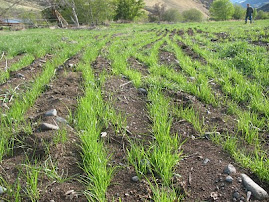
And what could be nicer than a leisurely meander across the bridge and upriver to the farthest stretch of reclaimed feedground, where the rangeland drill couldn't go, to the broadcast seeding, to see what our efforts had amounted to.

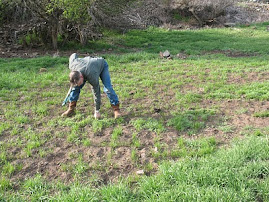
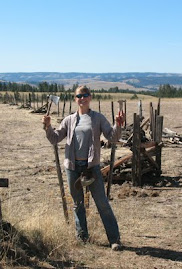
That's how it started, a simple hold-your-hand stroll through the field. But somehow a shovel entered into the picture, and not long thereafter, the uprooting and pulling of a scotch thistle here and there, and then the scuffing and scrabbling of kochia sprouts from among new grass seedlings. Before long I was hard at it in a clump of thistle rosettes with Mike up ahead, gloves wrapped around a stubborn root. When I finally stopped looking at the ground, he was gone, a telltale wire gate left open at the narrow end of the field.

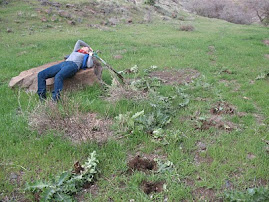
I laid my shovel down and ventured into the lush ribbon of alder, birch, dogwood, elderberry, box elder and rose. Rock rims crowded the channel, towering overhead and casting their cool shade onto the tunnel of trees. I crept under the hanging branches, looking for signs of boot tracks in the new grass. The river churned past, licking the banks, and the fresh leaves of the trees danced around me in the breeze. "ARRRRRRR!" came the inevitable roar as Mike jumped up from behind an ancient upended box elder.

We laughed and then continued on through the green tunnel to the end of the grove where the rims reached the water and cut off the trail. And we stood for a moment on a rock reaching into the current, where we could see a few Bunchgrass Beef cows grazing the spring grass on the far bank, the slant light of dinner time cutting into the canyon. Then we turned toward home, holding hands again, at least till we got to the thistle patch.


From Sara at Magpie Ranch, home of Bunchgrass Beef

Tuesday, April 13, 2010

Gap Fences

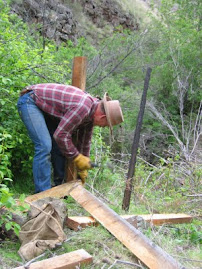
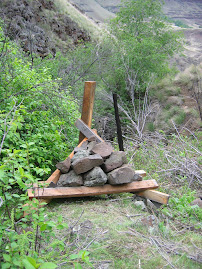
The fence we built last weekend is classic. Not in the traditional rock jack sort of way. More in the improvisational scrounge-and-scab-together way. As our new grass seedlings pop up in our restoration projects, some of those athletic Bunchgrass Beef cattle challenge our determined efforts to keep them from crossing the river and reaching the big bar on the west side. Not that they don't have nutritious bunchgrass greening up on the slopes and canyon benches, they just "like variety" as Mike puts it.

We are a few years into the restoration project on the west river bar where there used to be a feedlot. After the 1,000 year flood in 1997, the bar was colonized by six foot high kochia and other weeds transported in on the flood, and enormous piles of gravel and rock and woody debris were left behind in scattered spots on the broad flat ground.

When we first started the restoration project, we had to pull out the feeders, anchored by railroad ties that Mike and I toiled to set as posts over twenty years ago when we worked for the Phillips' family. It was really hard work setting those posts and I guess we did a good job, because it was really hard work getting them out too! After dismantling the feeders, we burned and pulled weeds and cut out washed up trees, etc. Then we drilled in seed with the the rangeland drill from the Soil and Water Conservation District.

This year we did our second round of drilling. Our first seeding took pretty good in some spots, but we wanted to get into areas that we couldn't seed the first time, and go back over some places where germination had been spotty. It's really rewarding to see grass instead of weeds and to see the diversity of plants and animals enjoying the habitat.

Last weekend we were improvising a gap fence between rock outcrops where the cattle were finding spots between the rims where they could jump down onto the river bank and then cross to the other side. We lugged a couple steel posts downriver and perched ourselves above a small rim along the east side of the river. The view of the historic camping place in the box elder grove and upriver across the bar was soothing in the warm spring sun, with the river gurgling past in one of our outstanding salmon fishing holes and a set of rapids tumbling off to the north.

Just below us, a Canada goose was setting on her nest in a cleft of basalt half-way up the rim. A great spot to get away from predators, but one of her eggs had rolled off the nest and sat out in the open, balanced on the rock ledge like an abandoned Easter egg. It would be fun to see how the goslings make their first jump off the nest and into the river some six feet below.

All day long the beautiful cliff swallows darted back and forth above the river. As they banked and turned catching insects in the warm air currents, their iridescent backs flashed in the sun.

Finally, just as we gathered up our dusty tools, a golden eagle drifted around the bend and flew overhead close enough for us to see the striations in his belly feathers.

The gap fence didn't turn out as tight as we would have liked, but it was a pretty good day out there with the birds.


From Sara, Magpie Ranch, home of Bunchgrass Beef

Friday, April 9, 2010

Ostern

I love those holidays like Easter that last for days with all our favorite things, like dying eggs and hunting eggs and eating eggs. And the cookies Prairie made to decorate in vibrant colors, our family gathered under one roof, sharing and playing, laughing at our kites jumping on the gusts of wind in bright sun along the river bar.

Any day now there'll be the first calf of the year on the Magpie Ranch, a lean little creature taking tiny knobby-legged leaps beside his mother.

I'm thankful for the moisture this past week, the snow and sleet and rain. For the native grass is growing along the benches and canyon slopes, and in the drill rows of our restoration projects, the new seed is germinating.

I know the river will come up in her banks and I try not to think of the herd crossing in their usual places, the little calves braving the current, their heads bobbing above the waves. I am reminded some things come naturally.

Each week brings new flowers, birds I am learning to know, with always a fencing job and cattle to be herded and lately, horses needing shod. I have planted more asparagus to join the feral sprouts in the garden, thick with equisetum. And I dug in a rhubarb start in hopes that all will survive the blaze of summer. Perhaps I want a reason to come back, when I can say, I've got to get to the river and water those plants...

Trailing the rocky slopes, I scan for buds on the prickly pear, their spiny limbs suddenly plump and tall after the wan and dessicated months of cold. It won't be long before their creamy yellow blossoms tinged with pink dot the canyonsides.

Green up. Glorious green up. It feels so good, I could almost eat the grass myself.


From Sara at Magpie Ranch, home of Bunchgrass Beef
Sunday, March 21, 2010

Ene and Azja

Six thousand miles. That's about how far Ene and Azja travelled to get to the Magpie Ranch. Nearly a quarter of the way around the planet, from Ulaanbaatar, Mongolia to Horse Creek on the Imnaha River.

We are very fortunate to have friends like these who teach us, question us and laugh with us. Yes, we learn about their country and lives, but we also get the rare opportunity to see our own work and culture through their young eyes.

Mike and Azja worked together the last time Mike was in Mongolia, and Mike wrote a letter of recommendation for Azja to get into graduate school in San Francisco, where he is working on a Masters in Developmental Economics. In Mongolia, they live in the capital city, (as Ene says,"I am not a countryside girl."), but like other urban Mongolians, they are only one generation removed from centuries of life as herdsmen on the Mongolian steppe.

Ene spent much of her childhood living a rural lifestyle with her grandparents while her mother studied to become a pediatrician. Milk and meat are the sustenance of Mongolian people. Thus Ene was prepared to inform me that camels give 15 liters of milk and are milked three times a day. At the ranch she kept saying,"You get milk from your cows, right?" "No, I said, "They are beef cows, we raise them for meat."

When we were hiking the bench trail on our way to fix fence, I pointed out one of my favorite Longhorns lying down, relaxing in the spring sunshine. Ene asked why that cow was special to me and I explained that she is calm, travels well, and raises a nice calf every year. Ene asked when the cow would have a calf and I said in a month. "Then you will milk her, right?" she asked.

The fact that we own cattle and buy milk from the store struck her as somewhat ridiculous. At least I was able to reassure her that some of our friends with cattle do have milk cows and that sometimes we buy milk from them.

Ene and Azja are part of a generation faced with the enormous responsibility of carrying their homeland forward in the transition from a command economy under Soviet communist influence to a capitalist economy under a struggling parliamentary government. There are roughly 3 million people and 40 million head of livestock in Mongolia. This year, more than 4 million of those animals are dead, with more expected to die as a result of the dzud, severe winter weather with extreme cold and high winds.

Rich in minerals and land, Mongolia is under pressure from international mining companies and land-starved nations. Migration to the cities from rural areas continues. Corruption in government is common. In the midst of economic turmoil and cultural change, family ties are still of utmost importance.

When summer break comes, Azja will leave San Francisco and return to Mongolia for two months. His mother said she needs him. I think he might not want to go, but he doesn't consider the possibility of saying no, not even for an instant. "Family is the most important thing," he says. "In Mongolia,we always help each other. Always."


From Sara at Magpie Ranch, home of Bunchgrass Beef

Friday, February 26, 2010

Living History

For Caryl Coppin, 1917-2010

It's nearly March and the first buttercups speckle the canyon slopes. Like shiny gold buttons on tiny stems, they tremble in the stiff breeze, resolutely facing south as if determined to absorb every possible ray of sun.

I lean over in the saddle and marvel at how many cups of gold there are today when just yesterday I counted only seven. We are riding after cattle and I'm glad. There are few jobs better than the ones that find us horseback in the canyon on the cusp of green-up, on a blue-sky day.

But a part of me wishes I were out in town, at the old stone church where I know people will be gathered. I could tell this story, of the buttercups, of alders trailing their ruddy catkins, and wild geese returned to nest in the tall grass. I could tell about the fisherman I didn't see, who swathed in waders, lost his footing and stumbled like a drunk across the cobble, how he set my horse leaping sideways up the bank and me flopping in the saddle with half a brain saying--what the heck, while the other half reminded me to reach down and grab a rein.

And there was more. The gather and turn of the cattle with shouts of "come by" and "away to me", the dogs circling and holding the herd. The splash across the river, our horses' legs inside the ripple, the deeply colored stones awash below. The nod of horns and the climb of haunches trailing upslope to benches spread in winter bunchgrass, golden with a hint of green. The long trot toward home and afterward the oily glow of kerosene at the dinner table and the home-cooked meal, last year's beef, some cellared spuds and squash.

Of all the people who would have told me to stay away from town, there's only one I listened to today. I can hear her plain as I can see her, the nod of silver hair as she waves her hand between us. Go on, I hear her saying. You've got work to do. And your husband, why I'm sure he's waiting.

And it's this love of living, in every chore and season, in labor and invention, in showing and learning how, in celebration and in passing, that keeps me here, among the cattle.

Yes, I could be in town. But here, she's riding with me, just behind the cantle with her slender arms around my waist, her story in my ear about how it used to be, and still is.


From Sara at Magpie Ranch, home of Bunchgrass Beef
Monday, February 8, 2010

Signs

I'm convinced. More than that, I'm delirious. How can such a simple thing as horses shedding gobs of long coarse hairs, clogging up the curry comb and sticking to me like velcro, elicit feelings of glee?

And, there were geese poking about in the bends of the river, and song birds arrived to flit and scurry in the brush, and, yes really and truly, there are buds on the willows and birches.

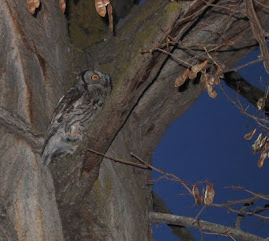
The final note to convince me arrived on Saturday night, when I heard the bouncing calls of the screech owls, returned to the locust grove to mate and nest and raise their young. The stars were fierce and I dragged Mike out of the warm house to help me look for constellations and listen to the owls. The blanket of stars was so thick it almost felt suffocating, like being outnumbered and scrutinized by a gazillion other worlds. Innumerable tiny sparks and closer to us, several large stars sharply pulsating in brilliant blue and orange.

I was searching for my old friends, the Seven Sisters. It's odd how stars befriend us, become like members of the family who you miss when they are gone and welcome back upon their return. When we lived at the equator, I felt little kinship for the night sky, even though I still longed for and appreciated seeing the stars. Where was the big dipper? I felt displaced, a stranger. By the end of the year, the Southern Cross was my new companion.

In the canyon, sky is reduced to whatever opening the ridges grant you in the particular spot where you are working. Places on the rivers, like Dug Bar on the Snake, or at Magpie on the Imnaha, give us more to consider. But tucked away in a narrow draw, like up Pumpkin Creek,there is only a sliver of sky to befriend us between the dark pines and heavy basalt walls.

So Saturday night as I stood under a span of sky, saying hello to the Seven Sisters, listening to the screech owl calling from the ancient locust tree behind me, with a carpet of cast-off dun horse hair beneath my feet, it was unmistakeable. February, the dying month, is also the harbinger of change.

Red and brown and tan will soon become the backdrop for winsome buttercups, then all manner of pink and white and yellow and purple and blue and orange will spring up, and shoots in every shade of green. I'm getting ahead of myself.

But one last thing. I could smell it. I could smell the river banks, coming to life, the mud and ooze, the day-warmed rocks, the rot. Glorious.


From Sara at Magpie Ranch, home of Bunchgrass Beef
Wednesday, February 3, 2010

February Storm

The storm that just came through dumped a ton of rain in the canyon. During the night we heard the rain on the roof, steady, steady, steady and woke up early to heavy clouds like a lid on the canyon. As the clouds shifted, the end of a high ridge above the house would poke through the storm. The glimpse of jagged snow-covered cliffs hovering above the clouds reminded me of Unuru, our Mongolian friend, who always referred to the canyon rims as “beautiful mountains.”

Our plan to ride for cattle quickly changed to a day working on corrals and outbuildings. With the top layer of soil on steep north facing slopes thawed and saturated, it was too slick, too mucky, and too soft for trailing.

The thermometer hovered at 36 degrees as sodden cold sucked at our bundled bodies, but I noted with glee the tiny green plants germinating in protected spots and the green shoots of grass poking up in the orchard. There is a turn in the air, and inside my own cells a small voice ringing the bell of spring.

After a fast hike to the bench to spot the herd left me with boots and jeans soaked through and hands damp and numbed inside their gloves, my thoughts were only on the woodstove and a mug of hot tea. The winter canyon has many labors to consider. And many gifts as well, as this poem from the Magpie Ranch journal reminds me.

February Canyon

This is an hour when all could find a will to live.
A solitary hour with no other human soul in sight, among the wind, the bleached grasses,
the rust colored locust pods in their transient, timeless places.

And the river, industrious, committed to its journey, as if each vesicle,
each droplet riffle-joined, had passed these rocks and willow-matted shores
uncounted times before, such that their passing now earns not a glance
or hesitation in the scour and fall and pour.

And shadows cut a mirror likeness of their great rimmed parents,
echoes of light so stark they seem more solid than the rock-ridged walls that cast them,
predictable in their march from day to night, a conquest far beyond the tiny paths of men,
and knowing every crack and frond and seep and newly tumbled stone.

This is the opera of our days, the great unfolding from which scatter forth
the reds and browns of story, the blues and greens of life, the germ and decay,
the blossom and fruit, the wing and song, the hum and foam, the toil.

We populate this place with more than those of us who are living.


From Sara at Magpie Ranch, home of Bunchgrass Beef