Monday, June 28, 2010

Hand Measuring

Hardly a day goes past when I am not reminded of my great teachers in life, the people who shaped my skills, desires and values. Some of these are far in the past, like Mrs. Jorgenson at Normandy Park Elementary, who let me paint my way through first grade (age 5) and Mrs. Anslow, the pianist, who tolerated my grubby horse-stained appearances on lesson day (age 12).

There are teachers among the members of my family, like my maternal grandfather, Lawrence Goodrich, the cabinet maker, who taught me that success means doing something you love. And my father, Ralph Miller, whose family was so poor they never owned a car and had to live in rented rooms, who showed me the vast riches of the natural world and the incredible gift of discovery, whether of a tiny plant on the bank of a creek, or of learning a new language and making cherished friends in a foreign country.

There have been so many wonderful teachers in my life, I could write an encyclopedia just listing them all. They are the jewels on my necklace of years. So each day I admire a few and give thanks.

Today I was thinking about Janet Wilson. I met Janet when we both had little kids and she was one of the toughest, hardest working women I knew. In spite of arthritis that was already crippling her wrists, she broke horses and worked in the fields and logging camps. I remember how she determinedly shod her own mule, trimming and rasping the hooves, then shaping and nailing on the steel shoes. It took her four days since she could only tolerate shoeing one foot per day.

Last Sunday I saw Janet for the first time in fifteen years. We met up at the Donnelly garden on the John Day River. Janet is hanging in there, hunkered down on the family homestead up Alder Creek. She can't saddle her old mare anymore, even though she can still ride.

What she can do is make incredibly beautiful beaded works of art. The richly colored glass of a garden-themed dream-catcher sparkled in the June sun as she gifted it to my niece for a new baby's room. Janet just finished a lamp shade that took four years to complete. Each piece is given away, inspired by the richness of giving.


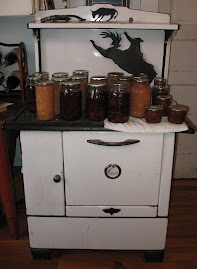
I was thinking of Janet while mixing up a batch of banana bread in my farmhouse kitchen here in the Wallowa Valley. I picked out the right-sized bowl, eyeballed the amount of mashed banana in the bottom, added oil, eggs, honey, flour, and measured, in the palm of my hand, the baking soda, baking powder and salt. Then it struck me, who taught me to cook without measuring cups?Without mixer or recipe? So that now, when my own daughter asks how I make waffles, or bread or gravy, I find myself struggling to describe the size of bowl needed, the amount of ingredients.

I realize I did not learn how to cook from anyone in particular. What I learned from friends like Janet, and so many other hard-working resourceful outdoor women, is that you don't need much to do a good job. You give it a try, you make mistakes and you get better.

That is not to say that I don't rely on cherished recipes from time to time. I still remember desperately wishing I knew how to make a lemon meringue pie and thinking it was a godsend to find a cast-off book, "The Bride's Guide for Living,"at the Imnaha dump. After forty pages of how-to on bridal registries, spring cleaning, and hosting cocktail parties, there appeared a few sample menus AND a recipe for lemon-meringue pie!

Yes I can now "eyeball" a pie, and I owe it, not to a fancy kitchen stocked with gadgets galore, but to the simple cow camps where just about anything you make tastes delicious.


From Sara at Magpie Ranch, home of Bunchgrass Beef


Tuesday, June 22, 2010

It Takes a Village

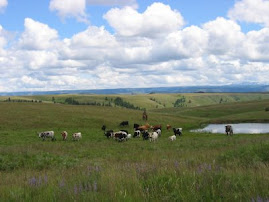
Or a family, at least. In our group effort, we safely trailed the cow herd from Horse Creek on the Imnaha River to the Zumwalt Prairie in three days.

Day one, Cammie and visiting niece, Maddie, brought the herd up the road and along the bench to Log Creek. Dawson even did some "herding" via stroller, the first time I've ever seen that attempted!

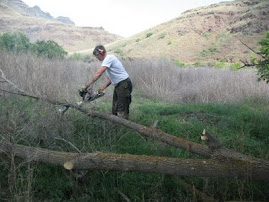
Zeke and Mike spent the morning clearing the Log Creek trail with machetes and hand saw, whacking through a jungle of blackberry, alder, and poison oak. Luckily Brian and Mike had done a major job of brushing out the trail last year so this June the job took significantly less time. Gabe and I got the herd started up the narrow draw and through the first gate where we left them overnight, hoping they would continue to climb up on their own during the afternoon and evening.

We all returned to the ranch house for a yummy barbecue, relaxing in the warm afternoon, playing horseshoes and fishing in the river. Except for Mike, who spent the evening resetting shoes on horses, getting them ready for the next day's work.


Day two, Mike and I took over, making our way up Log Creek. Travelling mostly on foot in a steady downpour, we slogged through shoulder high wet brush and up saturated side hills so slick even our horses had trouble keeping their feet. Finally the rain quit and a bit of sun even came out as we reached the cows, who had indeed continued up the draw and were now lounging near the last steep pitch. The weather was something like I imagine Ireland to be, and the canyon below unfolded in a stupendous light show of clouds, sun and shadow.

Our job was made somewhat easier since Mike had already hauled most of the steers to our other summer range near Hurricane Creek at the foot of the Wallowa Mountains. This left us with fewer animals to push up to the ridge top.


Nevertheless, the last pitch was brutal. Leading Mestizo and Bird, I would scramble up about ten yards at a time, then perch between the two horses as all three of us caught our breath for a minute. I thought, well I guess if it's hard for the horses, I shouldn't feel bad about it being so hard for me.

Mike was up above me, handily working the dogs on foot as he switch-backed the herd up and threaded them between a couple small rims of rock and topped out into the timber of the canyon breaks.


Hallelujah. I was so happy to be able to get back into the saddle, and so thankful to have my horse under me for the rest of the day.


The cows travelled well along the top, in spite of the occasional traffic, wood cutters, noisy motorcycle riders, rigs hauling trailers, gawking tourists, etc. The ominous weather had drawn closer, with pitch black clouds off to the east. We were accompanied by thunder and lightning for several hours and the temperature turned cold, but fortunately we did not get dumped on by any of the numerous downpours all around us. We finally passed Thomason Meadows and soon the Steen Place came into view. I was flooded by memories of the many years we lived and worked that range, living in the historic two story log house, reclaiming it each summer from the pack rats and mice.

Now part of a vast private hunting preserve, the abandoned house, barn and corrals sit unused beyond new locked gates. As we rode past the huge holding pasture west of the barn I remembered how Mike, then the "new man", used to wrangle the horses out of that big pasture every morning. We were living in a wall tent in the yard as the house was getting some repairs and at daybreak, our foreman would holler out the door of his camp trailer, "Hale! Get those horses in!"

I remember filling in for Mike a few times, escaping motherhood in the soggy tent for the back of a horse. It was always a bit hairy, as the pasture was so large and the horse herd was often at the far end. As I approached the herd, my saddle horse would get all riled up and then the herd would stampede past. Since I really couldn't hold my horse back, I just tried to stay on as we flew over the wet rough ground, dodging hidden badger holes and leaping little washes alongside a rumpus of bucking and farting horses.

Now the meadows were silent as we trailed past with our bunch of longhorns. I gave thanks, drinking in the smell of a place that was so much a part of our lives, our growing up as parents and our learning how to live and work.

As we reached the corner by Vance Knoll, Gabe and Zeke met us with a thermos of hot coffee and some dry clothes. The cows were tired and it was getting colder, so we decided to call it good for the day and dropped the herd for the night.

In the morning on day three, we took the cows the last little bit up the road and turned them down across the Four Hundred Acres and through the gate onto the summer pasture, right where they belonged. As we rode back to the truck, I couldn't help looking across the prairie where the dark fingers of timber met the green swales of grassland, remembering our new neighbors, the wolves, and hoping that our tough mother cows with their substantial horns would do well to remind the wolves that there was other better prey on the range.

From Sara at Magpie Ranch, home of Bunchgrass Beef

Tuesday, June 15, 2010

One Step Closer


The sun appeared and dried out the corrals just in time for branding last weekend. It was hot, but not too hot. The cattle gathered easy in the early morning cool and the box elders provided some shade for the branding corral. Our crew of Zeke, Gabe, Mike, Cammie, Sara, Dawson (yeah, I know he's only two) and Danish exchange student, Laura Wang, handled the job well.

Mama cows with their baby calves were happily back munching lush canyon grass by afternoon while the branding crew enjoyed a feast of delicious Bunchgrass burgers, fresh salads and homemade rhubarb custard pie. We deserved it!


After the work was done, and our hunger satisfied, we relaxed and enjoyed the beautiful warm day. When things cooled off, Laura, Cammie and I took a leisurely ride along the Imnaha River. The temperature was balmy and the evening light bathed the high red rims and green carpeted canyon slopes. A gentle breeze rustled the thick ribbon of trees hugging the river and everywhere birds sang and darted above us in the softly descending evening.


I felt like we could have just kept going, clear to the Snake River, our horses' rhythmic hoofbeats in the moist dirt, the soothing sway of the saddle beneath me, the clean soft air on my bare arms, with just a hint of summer's brutal heat.


Before we knew it we had ridden longer and travelled farther than we intended. So we turned and took the long trot toward home, grateful to have had those few hours to remember how blessed we are to be doing this work, to have these animals to care for, to spend another day in the canyon surrounded by the memories of those who were here before us, who taught us and whose encouragement we still need.

Yup, with the branding done, we're one step closer to starting up the trail to the summer range.

From Sara at Magpie Ranch, home of Bunchgrass Beef


Monday, June 7, 2010

When it Pours

Last week I had the pleasure of laying eyes on my neighbors. It wasn't on the range, but rather in a basement conference room where we were meeting to discuss the future of grassfed beef. Two young women I've known all their lives, come home after college to begin the next generation of work on their family ranch. I wanted to know how they were. They wanted to know how the longhorns were. With cattle like ours, sometimes the cows are more interesting than we are.

I assured them the longhorns were great, lolling in lush grass, in no hurry to leave the canyon benches for the summer ground. The girls on the other hand, had been hard at it going over miles of fence out on the prairie, trying to patch up a mess left behind from rush-hour at the elk-way.

Several extra large elk herds decided to spend more time on the private prairie lands than on the public lands this winter. A few landowners became concerned about the loss of feed that they were counting on when the time would come to bring their cows out to the summer range. So a "hazer" was hired. I believe his job was to encourage the elk to move back toward public rangeland, where they could happily munch their way toward summer.

However, between the elk and the public land are a lot of fences. Fences people need to keep their cows where they are supposed to be. Fences that keep certain ground from being over grazed and encourage cattle to use other ground. Fences that keep our longhorn bulls out of the neighbors' hornless herds. Fences that keep cattle out of riparian areas or in holding pastures.

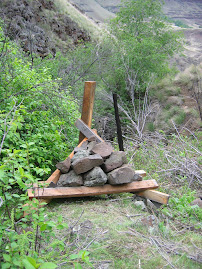
Some of those fences are almost twice as old as I am. Those are "historic" fences, a testament to good split material, like tamarack, and yucky, but effective barbed wire. The crux of them all is a decently constructed rock jack, crib or half crib. It's amazing when you think of all those miles of fence defying gravity for years and years and years. And then you think of the guy who built that fence for the very first time, back when you could ride to the nearest grange hall every month and stay up all night dancing and eating sandwiches and pie.

The girls had been out on the prairie in the pouring rain for two days. Stretching, splicing, stapling, hammering, staying, hefting, and pounding. They looked slightly disgusted just mentioning it. And yet, somehow even fencing in the rain makes a person feel useful. It's necessary and you know somebody somewhere is really appreciating the fact that you're out there doing it and they aren't.

When it pours everything is wet. When it pours for six out of seven days a week for a couple weeks, everything is saturated. We all know we're only a cloudburst away from disaster. Just across the Wallowa's, a storm cell parked above North Pine Creek, swelling the creek into a raging river that carved off football field sized sections of a major road. Bridges washed out, houses were flooded.

At Horse Creek, the Imnaha left its banks overnight, but we got by with minor flooding and our bridge was impassable for only half a day. Still, with the memory of the massive 1,000 year flood event of 1997, we never turn our backs on the river when there's this much rain.

I'm watching the grass grow and it's like getting an awesome interest rate on the money in your savings account. Out in the valley, an odd silence lays across the afternoon fields. No shush-shush of irrigation sprinklers. The farmers quit irrigating weeks ago. It's just too wet.

I don't know much about climate change, but I know our part of the world is supposed to get "warmer and wetter". This spring it feels more like colder and wetter, with the coldest May on record and people's lawns beginning to look like hayfields just before first cutting.

The sunset tonight was unexpectedly beautiful, the violet stretch of sky, fiery rays of sun turning salmon, then muted tangerine along the ridged horizon, fading upward in faint rainbow layers through yellow into green, into robin's egg blue into navy blue into midnight blue. I'm stunned by the expanse of it, by the color! Grey day after grey day, smothered by rain clouds, I'd forgotten how beautiful our summer evenings usually are. So for now, I'm loving every minute of sun, still thankful for the rain, just hoping it will let up a bit so we can all dry out for a change.

From Sara at Magpie Ranch, home of Bunchgrass Beef

Friday, May 7, 2010

Calves on the Ground

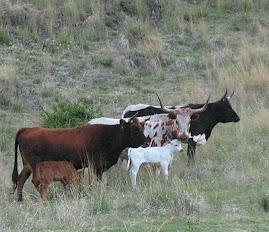
The first Bunchgrass Beef calves of 2010 are on the ground! We're about half way through calving and with the new grass coming on, calves and mamas are happy. Little Basin has an almost all white calf with red ears! It's cavorting season and I'm jealous because the last few times I've been at the river, all the pairs have been high on the canyon bench and all I've seen are steers, yearlings and cows that haven't calved yet. Yes, I did see some of the little critters with the binoculars, but that doesn't count.
We picked up a good-looking black longhorn bull to add to the herd for the summer as well as a young red longhorn bull who will have another year before we put him to use. We said goodbye to Fred, our awesome tri-color bull, who we sold to a ranch out north where he can be in heifer heaven with a new harem for a few years.

In spite of the six inches of snow that arrived on May 5th, we know summer is right around the corner. In another month we'll be thinking of turn-out and trailing the herd to the summer range on the Zumwalt Prairie. Before then we'll gather family and friends for the annual branding, hopefully when it isn't too unbearably hot. Last year we set the date and then it turned out to be about 100 degrees. Right now I can't really imagine it's going to be so hot that I'll want to jump in the swimming hole, but I know it's coming. That and cherries and blackberries and plums and homemade ice cream and barbecues and sitting around the fire with the guitar and concertina, watching the stars blink on in a violet blue sky.

From Sara, Magpie Ranch, home of Bunchgrass Beef

Monday, April 26, 2010

Date Night in the Thistle Patch

Sunday late afternoon, a gentle breeze blowing down the river, the golden light settling on vibrant new grass, Bunchgrass Beef cows high on the benches with their frisky new calves...all was well on the Magpie Ranch.

The dirty work of digging out the crawlspace and putting in new conduit for the solar power was done. The first go round on the lawn with the stinky hard-pushing gas mower, whacking it all down before snakes and grandchild had a chance to meet unexpectedly. Another ride on the sassy new mare. The bumpy drive up to Pumpkin Creek to seed grass on the fresh dozed tracks where the road was relocated out of the creek. And in between it all, the non-stop antics of the almost-two-year-old grandson.

Time for a break. Time to sit on the porch, letting it all sink in: the greening range, the merganzers zipping low through the air heading downstream, the current high and silty frothing over the rapids and sucking at the willows, the fruity-sweet scent of apple blossoms and the heady perfume of lilacs. And sun, glorious and warm, bathing red rock and red osier and purple brodia and yellow sunflower.

And what could be nicer than a leisurely meander across the bridge and upriver to the farthest stretch of reclaimed feedground, where the rangeland drill couldn't go, to the broadcast seeding, to see what our efforts had amounted to.

That's how it started, a simple hold-your-hand stroll through the field. But somehow a shovel entered into the picture, and not long thereafter, the uprooting and pulling of a scotch thistle here and there, and then the scuffing and scrabbling of kochia sprouts from among new grass seedlings. Before long I was hard at it in a clump of thistle rosettes with Mike up ahead, gloves wrapped around a stubborn root. When I finally stopped looking at the ground, he was gone, a telltale wire gate left open at the narrow end of the field.

I laid my shovel down and ventured into the lush ribbon of alder, birch, dogwood, elderberry, box elder and rose. Rock rims crowded the channel, towering overhead and casting their cool shade onto the tunnel of trees. I crept under the hanging branches, looking for signs of boot tracks in the new grass. The river churned past, licking the banks, and the fresh leaves of the trees danced around me in the breeze. "ARRRRRRR!" came the inevitable roar as Mike jumped up from behind an ancient upended box elder.

We laughed and then continued on through the green tunnel to the end of the grove where the rims reached the water and cut off the trail. And we stood for a moment on a rock reaching into the current, where we could see a few Bunchgrass Beef cows grazing the spring grass on the far bank, the slant light of dinner time cutting into the canyon. Then we turned toward home, holding hands again, at least till we got to the thistle patch.


From Sara at Magpie Ranch, home of Bunchgrass Beef

Tuesday, April 13, 2010

Gap Fences

The fence we built last weekend is classic. Not in the traditional rock jack sort of way. More in the improvisational scrounge-and-scab-together way. As our new grass seedlings pop up in our restoration projects, some of those athletic Bunchgrass Beef cattle challenge our determined efforts to keep them from crossing the river and reaching the big bar on the west side. Not that they don't have nutritious bunchgrass greening up on the slopes and canyon benches, they just "like variety" as Mike puts it.

We are a few years into the restoration project on the west river bar where there used to be a feedlot. After the 1,000 year flood in 1997, the bar was colonized by six foot high kochia and other weeds transported in on the flood, and enormous piles of gravel and rock and woody debris were left behind in scattered spots on the broad flat ground.

When we first started the restoration project, we had to pull out the feeders, anchored by railroad ties that Mike and I toiled to set as posts over twenty years ago when we worked for the Phillips' family. It was really hard work setting those posts and I guess we did a good job, because it was really hard work getting them out too! After dismantling the feeders, we burned and pulled weeds and cut out washed up trees, etc. Then we drilled in seed with the the rangeland drill from the Soil and Water Conservation District.

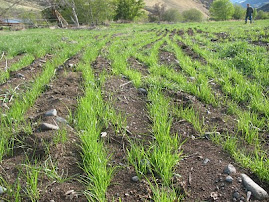
This year we did our second round of drilling. Our first seeding took pretty good in some spots, but we wanted to get into areas that we couldn't seed the first time, and go back over some places where germination had been spotty. It's really rewarding to see grass instead of weeds and to see the diversity of plants and animals enjoying the habitat.

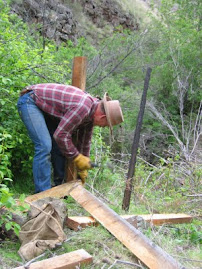
Last weekend we were improvising a gap fence between rock outcrops where the cattle were finding spots between the rims where they could jump down onto the river bank and then cross to the other side. We lugged a couple steel posts downriver and perched ourselves above a small rim along the east side of the river. The view of the historic camping place in the box elder grove and upriver across the bar was soothing in the warm spring sun, with the river gurgling past in one of our outstanding salmon fishing holes and a set of rapids tumbling off to the north.

Just below us, a Canada goose was setting on her nest in a cleft of basalt half-way up the rim. A great spot to get away from predators, but one of her eggs had rolled off the nest and sat out in the open, balanced on the rock ledge like an abandoned Easter egg. It would be fun to see how the goslings make their first jump off the nest and into the river some six feet below.

All day long the beautiful cliff swallows darted back and forth above the river. As they banked and turned catching insects in the warm air currents, their iridescent backs flashed in the sun.

Finally, just as we gathered up our dusty tools, a golden eagle drifted around the bend and flew overhead close enough for us to see the striations in his belly feathers.

The gap fence didn't turn out as tight as we would have liked, but it was a pretty good day out there with the birds.


From Sara, Magpie Ranch, home of Bunchgrass Beef