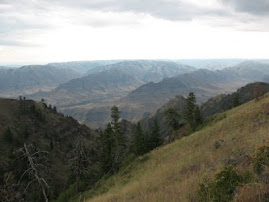
The storm that just came through dumped a ton of rain in the canyon. During the night we heard the rain on the roof, steady, steady, steady and woke up early to heavy clouds like a lid on the canyon. As the clouds shifted, the end of a high ridge above the house would poke through the storm. The glimpse of jagged snow-covered cliffs hovering above the clouds reminded me of Unuru, our Mongolian friend, who always referred to the canyon rims as “beautiful mountains.”
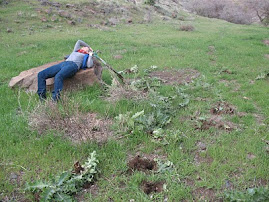
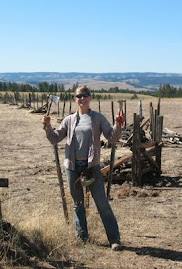
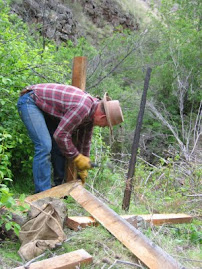
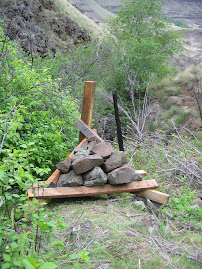
Our plan to ride for cattle quickly changed to a day working on corrals and outbuildings. With the top layer of soil on steep north facing slopes thawed and saturated, it was too slick, too mucky, and too soft for trailing.
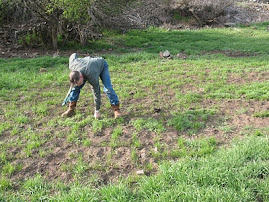
The thermometer hovered at 36 degrees as sodden cold sucked at our bundled bodies, but I noted with glee the tiny green plants germinating in protected spots and the green shoots of grass poking up in the orchard. There is a turn in the air, and inside my own cells a small voice ringing the bell of spring.
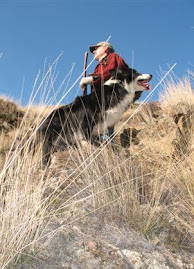
After a fast hike to the bench to spot the herd left me with boots and jeans soaked through and hands damp and numbed inside their gloves, my thoughts were only on the woodstove and a mug of hot tea. The winter canyon has many labors to consider. And many gifts as well, as this poem from the Magpie Ranch journal reminds me.
February Canyon
This is an hour when all could find a will to live.
A solitary hour with no other human soul in sight, among the wind, the bleached grasses,
the rust colored locust pods in their transient, timeless places.
And the river, industrious, committed to its journey, as if each vesicle,
each droplet riffle-joined, had passed these rocks and willow-matted shores
uncounted times before, such that their passing now earns not a glance
or hesitation in the scour and fall and pour.
And shadows cut a mirror likeness of their great rimmed parents,
echoes of light so stark they seem more solid than the rock-ridged walls that cast them,
predictable in their march from day to night, a conquest far beyond the tiny paths of men,
and knowing every crack and frond and seep and newly tumbled stone.
This is the opera of our days, the great unfolding from which scatter forth
the reds and browns of story, the blues and greens of life, the germ and decay,
the blossom and fruit, the wing and song, the hum and foam, the toil.
We populate this place with more than those of us who are living.
From Sara at Magpie Ranch, home of Bunchgrass Beef
Wednesday, February 3, 2010
Saturday, January 2, 2010
Plucky Lucky
If there were a Biggest Loser for horses, Lucky could have been a winner. It was spring when he arrived at the ranch, fresh off valley pasture and fatter than a tick. It looked like he had been that way for a long time. A middle-aged gelding, flea-bitten grey, Lucky was barely fifteen hands tall, with a fairly refined bone structure and probably had some Arab blood in him. He was one of four horses in the string provided by our new employer when we moved to Brown Canyon. The others were Podunk, Mary, and Lady.
All of them were rejects of a sort. None had been ridden in ages, a telltale sign that our new employers were mainly valley farmers who had recently leased some canyon range for their cowherd. The mares, Mary and Lady were too old to gain much weight. The bay gelding, Podunk was pretty larded up, but he was bigger framed than Lucky and carried the weight more spread out on his body. Lucky looked like a ball with appendages. If he fell over on the trail, it seemed he might just keep rolling.
Our job was to run 150 yearling heifers on several thousand acres. The heifers had never been in the canyons before and we were supposed to keep them healthy and on the gain until fall. We were also supposed to keep them from getting bred, something which proved a significant challenge, given the state of the few existing fences and the tenacity of the Angus bulls on the neighboring range.
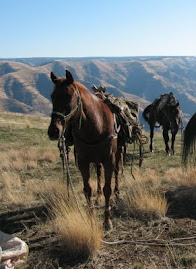
The ranch buildings sat close to the mouth of Brown Canyon. We were housed in a pink single-wide New Moon trailer with a big room built onto one side. We had two kids then, five and three, and they slept head to foot in a single bed until Mike built some bunks. From the trailer, there was an open view down the bench above the Imnaha River and we could see Indian Village high up across the canyon near the breaks of the west rim. The main trail to the summer range headed east, up the creek behind the ranch buildings where the Brown Canyon rose narrow and steep to the top of Grizzly Ridge. We could ride from the house and reach the summer range in just over an hour.
It was a pretty good trail once we got it brushed out, steep, with a few rock outcrops, but you could still find your way down in the dark if you had to. The worst part for me was locating the beginning of the trail from the top where the range was open with grassy swales spreading north and south above the rims. I had many a false start, poking into one draw after another, looking for the way home before I learned my way around and didn’t have to worry about rimming out on some big drop off.
Lucky struggled with that trail. Up or down, either one is hard on a fat horse. We dry lotted him on hay to help him drop the weight, but we still had to use him. Yearling cattle are like teenagers, curious, impulsive and athletic. Between riding the fenceline, herding the neighbor’s bulls, and keeping track of the heifers, all the horses got a workout.
Riding Lucky that spring made me nervous. Not because he was ornery or badly trained, but because I worried he was about to have a stroke or a heart attack. I led him a lot, but eventually I’d have to get on. He’d start up the trail and he’d be huffing and puffing, and pretty soon I could feel his chest heaving and his heart pounding so hard between my legs I thought he was about to explode.
One thing about Lucky was that he never gave up. In spite of being smallish, middle aged, and grossly overweight, he kept trying. Plucky Lucky we called him. Even after he got into shape, there was a feeling of trepidation as he doggedly started the climb up the creek. He never seemed to forget how hard it had been, never seemed to realize how capable he was.
Lucky was really a pretty decent little horse, his gaits were smooth and his mouth was soft. However, he did have a problem that he never got over. He didn’t like anything flapping around near his back. As long as you paid attention, and didn’t try to get your rain slicker on while riding, he was fine.
Our other fat horse, Podunk, was young enough to resent being put to work after a life of leisure—lolling about in irrigated pastures. One day Podunk pitched a fit and caught Mike off guard, throwing him into a pile of rocks. Mike showed up back at the house, grey in the face and clutching his left shoulder. Flinny, the cowboy with him, couldn’t stop laughing about how funny it had been, the fat gelding humped up and Mike flying through the air. A trip to the emergency room and three weeks off with a dislocated collar bone made it harder for me to see the humor of it.
There was no doubt that although Podunk was young and strong, he was a handful, and Flinny refused to ride him. So when Mike got back to work, he used Podunk for the most part, while Flinny saddled Lucky or one of the old mares for the climb to the ridge top. One evening after the horses were turned out and dinner was over, I kept noticing Mike with a smirk on his face.
Finally, I asked, “What’s so funny? What are you laughing about?”
“I can’t stop thinking of the look on ol’ Flinny’s face when Lucky took off with him in a pile of rocks today,” he grinned. “Caught Flinny totally off guard, the more Flinny flopped around, the more it freaked Lucky out. Ol Flinny was bellering like a stuck calf, took him forever to get Lucky stopped.”
“What caused that?” I asked.
“Well,” Mike said, “It could have been me riding up behind and flapping my arms a couple times.”

Christmas Day
"Why can't we have beef?" Mike asked. True, with all the delicious Bunchgrass Beef in our freezer, we never seem to eat beef on Christmas. So this year, we shouldered aside the locally raised turkey, and hefted three roasts into the wood cookstove.
Sometimes I wonder about food being the center of our celebrations, especially with all the sweet, sticky, crunchy, iced, dipped, and sprinkled treats. Then I get a package of stollen in the mail from my sister who lives in a ghost town in the high desert, and I rip it open, eager to toast my first hunk, slather it in butter, and maybe even, oh Lord, dab on some of her quince jelly.
Food can be a gift of love. Such it was that we gathered with two other families on Christmas Day, to relish not only the three roasts, succulent and savory, but also an enormous brick of scalloped Prairie Creek Farm potatoes (took three hours to cook), green beans with shallots and red pepper, Grandma Lorry's hot-out-of the oven cloverleaf rolls, mounds of fresh greens with lemon juice/olive oil dressing, and raspberry-huckleberry topped cheesecake.
Rounded out by our other traditions of wild rope swings in the hay mow, brisk walks through the fields, non-stop music jamming in the living room and a relay of board and card games, it was a simply lovely Christmas. Sigh.
Wednesday, November 18, 2009
Out with the Plymouth, in with the Oval
Floyd Peterson’s staggering collection of junk, mostly metal scrap, was stored in and around an enormous well-weathered building next to the old Mill Pond in Enterprise. Somehow Mike figured that amongst all that junk Floyd might have a cookstove, which Floyd did, which is how for the grand sum of $25 we became proud owners of the Plymouth.
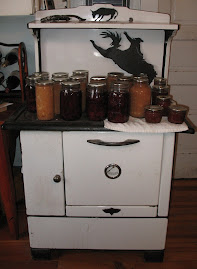
“It’s all there,” Floyd said, pointing to a pile of metal that he claimed was a functional wood stove. “We raised six kids on it and it’s been right there ever since I took it out of the house.” Mike brought the pieces home and indeed, it was all more or less there, from the somewhat-repaired firebox, to the black-trimmed white porcelain warming shelf, to the oven temperature indicator reading: “warm–slow-medium-hot-very hot.”
For twenty-five years, the Plymouth served us well. It was about as non-airtight as it gets and wouldn’t hold a fire for more than an hour (well, maybe longer if you put some apple wood in it). At baking temperature, the inside of the oven would be 500 degrees in the left rear corner and 300 degrees in the right front. If you forgot and set something breakable on the warming tray, it would soon vibrate toward the edge as people walked past and then fall off and shatter on the cast iron stove top.
In short, the Plymouth was a beloved fixture in our otherwise frigid farmhouse. The center of every winter morning, and every holiday gathering, loaded with simmering and baking foods, a place to dry out and warm up after cold, tiring work, the Plymouth was like an alter in the middle of our lives.
Several firebox repairs and about 150 chords of wood later, we’re not exactly getting rid of the Plymouth, we’re just putting her into semi-retirement. We’re modernizing. For our thirtieth wedding anniversary Mike gave me a brand-new modern, efficient, wood cookstove. As of this very moment, all six hundred pounds of the Oval are resting on the new tile hearth Mike built, hooked up to the new insulated chimney that Mike put in, burning a toasty fire of wood that Mike and Zeke harvested. She’s a beaut.
The old Plymouth hasn’t quite made it out of the kitchen yet, but will likely head to the canyon to take up a service in the ranch bunkhouse. She’ll need a new firebox first. And the bunkhouse needs new sills, a chimney, a door…it could be a few years. But that’s okay. If there’s one thing I’ve learned, it’s that a useable cookstove is worth hanging onto.
From Magpie Ranch, home of Bunchgrass Beef
Monday, November 9, 2009
Hairy Lucy
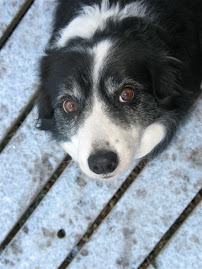
She didn't start out that way. When Prairie and I took pick of the litter, Lucita La Luz was a silky sweet pup with prick ears. We chose her for her confirmation and personality, which we hoped mirrored her grandmother, Bonnie, one of our favorite dogs.
Lucy joined the pack, at that time consisting of Oso, Bonnie and Chili, and assumed her role of relentlessly harassing the older dogs. Since she was too young to work, she did her best to herd the other canines at the ranch, racing ahead to cut them off and nipping at their legs, necks and shoulders. She was a colossal pest. But since all the other dogs had exhibited this same behavior as pups, they tolerated her or sent her packing with a no-nonsense growl.
When Lucy was about a year old, she and I were walking the fields behind the farmhouse when a coyote popped up from the marsh and loped off across the stubble. Lucy spotted him and took off like a rocket. I let her go, thinking this would be a good time to work on a call back, to get her to break her focus and listen to me. The coyote was a long ways off and I knew there was little chance of her ever getting close to it.
Her speed was unbelievable. I was so impressed that I just let her run. As I watched her churn across the field in a cloud of dust, it reminded me of the old roadrunner cartoons. She was humming.
I came to my senses and called her back, whistling long and sharp into the morning. When she heard me, she turned and ran all the way back to where I waited at the pond. She galloped up, tongue lolling, flashing a smile as if to say, "Now that was fun."
Lucy taught me an important lesson about communication. She was a pup when Zeke was in grade school and he loved to call her into his lap, where she would jump all over him and lick his face. As she grew older, this behavior transformed into a tightly coiled, forty-pound leap launched at your face as you walked across the yard. I hated it. Visitors like it even less.
I tried everything to break this habit, but nothing worked. Finally after two years, it clicked. She was not misbehaving, she was obeying a command. Zeke had trained her to "give kisses" and the command for this action was to look down at her and make eye contact. As soon as I figured this out, I stopped giving the command. When she bounced over to me in the morning, I looked straight ahead, said, "Sit" and held my hand out flat at my side.
At first she would sit obediently, but when I then tipped my head to look at her, she would jump, bam, teeth-first into my face. So I tried looking straight ahead and then petting her without looking down. It worked. I asked others to do the same and after a year she stopped jumping up altogether. It's amazing what we teach each other without meaning to.
Lucy was about four when she went to graduate school. She and Mike headed to the US Sheep Experiment Station in Dubois, Idaho where they grazed sheep on knapweed and developed protocols for controlling invasive species using livestock. Lucy was our first dog who could work both sheep and cattle.
Back in Wallowa County, she worked hard and eventually retired at age ten. The older she got the hairier she got. Her undercoat grew more and more dense and she never seemed to shed out all the way. Combing and brushing helped, but she was still a magnet for burrs and seeds. After two expensive trips to the vet to remove foxtail embedded in her abdomen, I took to shaving her each spring. When several friends appeared on the scene with dogs that were also named "Lucy", she became first Big Lucy and then Hairy Lucy.
In her last chapter of life, Lucy was the grandkid dog, the sweet old beast that would stand while one-year-old Dawson patted her back and grabbed handfuls of her ruff. As long as she got a chance to snake a tongue in his face every now and then, she was happy to put up with him.
Saturday Lucy went to meet her maker. Zeke and I dug the hole and the younger dogs, Newt and Ruby, came over to give her one last sniff. I laid my hand on her back, "Lucy, you were a good dog," I said. "Ashes to ashes and dust to dust," said Zeke.
If anybody comes over to pay their respects, you can find Lucy's final resting place out back in the dog cemetery next to the native grass nursery. Her's is the one with the deep red basalt stone.
From the Magpie Ranch, home of Bunchgrass Beef
Saturday, October 17, 2009
Heads and Hides
They are beautiful, these animals we have chosen to raise and live with and to respectfully harvest and appreciate as a source of food.
The harvest went well. Now the Bunchgrass Beef from Magpie Ranch is carefully aging, soon to be skillfully cut and packaged for each family who is waiting, freezer at the ready, to receive this year's bounty. I am thankful.
I am also thankful for all the work that Mike has put into preparing the heads and hides of these amazing animals. He skins and cleans each head and puts it away to dry. In a year or so, each stark skull with its impressive horns, will be ready for sale to provide another source of income to sustain the ranch.
There is something about taxidermy that creeps me out, but I don't feel that way about skulls. Perhaps this is because out on the prairie and in the canyons, bones are part of the landscape. Sun-bleached and porous, each holds testament to an individual life. The skulls of deer, cattle, and elk are more common, but an unusual skull is something to ponder. I cradle it in my hands, How tiny the skull of a mouse! How interesting the teeth of a badger!
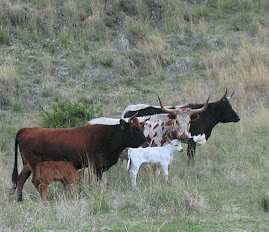
Each skull from the Bunchgrass Beef herd is unique. Some have long swooping white horns delicately tipped in black. Some have powerful short horns that arc inward. Some have horns that jut forward, like tines on a pitchfork. I admire them all.
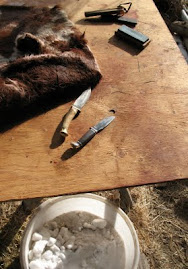
For the hides, Mike painstakingly cleans the flesh side and generously rubs fine salt into each hide. Then the hides are folded and put away to dry. After cleaning and salting, they can be safely stored until we are ready to have them tanned, either as regular leather, or with the hair on for rugs or upholstery. Each one is unique and a pleasure to look at.
I'm glad that today, when I look at a skull or a hide from an animal out of the Bunchgrass Beef herd, I can feel a sense of peace. I am thankful that each animal had a life well lived as part of the herd in a wild and beautiful place.
From Magpie Ranch, home of Bunchgrass Beef
Tuesday, October 6, 2009
The Third of October
Snow. Closing in like a flour sack being cinched around our valley.Where were the mountains? Where was the neighbor’s house at the far side of the field? I could barely see the barn through the frigid wet clouds that had settled onto us like a hen on top of her nest.
We were building corrals as the snow fell ceaselessly, heaping up on surfaces like some kind of water-saturated frosting. Jarred loose by our hammer blows it splatted in little glops on our hats, shoulders, hands.
As we pounded and sawed and measured, wrapped in our slickers and wearing our winter boots, we kept saying, “Wasn’t it ninety-one degrees a week ago? We were out in the yard in shorts and t-shirts, barbecuing up Bunchgrass Beef burgers!”
I escaped the wet and the hammering and headed to the kitchen to start lunch: a huge pot of minestrone soup, batches of yeasted rolls and apple pies. Zeke and three friends from Portland, a couple more friends from Enterprise, and Bryan and Tanyia were here helping and before long, the wet and hungry hordes would need a warm and tasty refuge.
There is nothing quite like coming into a savory kitchen, dumping your sodden muddy layers in the porch, and being enveloped in the smell of soup simmering, bread baking, and bubbly cinnamon-apple pies resting on the sideboard. A hot beverage is pressed into your hand, and you wedge into the circle at the table, elbow to elbow, stories and laughter swirling around you as your weary muscles relax and good food fills your belly.
Saturday showed me more of the ‘neighborly economy’ that goes into the raising of Bunchgrass Beef. The untimely snow may have dampened our labors, but the spirit of camaraderie kept us going. Night began to fall and with it snow-laden trees that collapsed onto power lines taking out the power at farmsteads all along Prairie Creek. We lit lanterns and candles and pulled out extra blankets, grateful for the warmth of friendship and the old upright piano, as the timeless music of familiar hymns filled the living room.
From Magpie Ranch, home of Bunchgrass Beef
Subscribe to:
Posts (Atom)