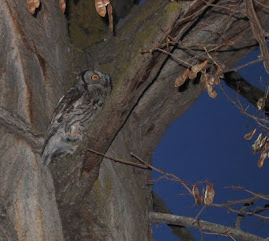
On the cusp of autumn, the owls are back in the cottonwoods. All week long I wake again and again to hear them. Calling. Calling. Their softly feathered voices like sonorous drums carrying a message along the watercourses of the valley.
I don’t know what brings these great horned owls from their usual haunts to our tall cottonwoods each year. During the summer, we see them perched on power poles or swooping out of the tops of willows and gliding off into the dusk. But late winter and early fall they join us for a week or so, settling in outside our sleeping household and gently waking us in the dark hours. I am impressed by their persistence, their meditative calls that go on and on. I wonder what they are thinking.
Owls are one of my totems. As a child, I grew up on salt water in the land of coastal tribes. Dark fathomed arms of the Pacific reaching into the continent to lap fir-covered humps of land. Even in this dry country where I now live, I feel a tiny totem pole shaped inside me. Significant, recurring experiences,indelible over time. What I carry with me.
At our first home in the canyon, I was often with owls. At the edge of a vast grassland bench, Tulley Creek nestles into the draw with red rock rims stair-stepping to the breaks above. It’s a special place. But I was struggling with the isolation of a woman in a man’s world, and hardly any men at that. It was like being on a tether, trapped in the snare of two babies under the age of two. Diapers piling up, everything washed on a board.
One long evening in August, I stood in the screened porch looking east when a tiny screech owl landed on the gatepost at the end of the boardwalk. Another owl landed on the other post. They perched quietly, their heads swiveled backwards. I had never been so close to an owl.
I stepped inside and picked up the crawling baby, took the other child by the hand. “Look at the owls,” I whispered, kneeling in the porch doorway. Dusk was falling and the orange tabby kittens began tumbling out of their lair in a mass of daylilies crowding the porch. Suddenly I knew why the owls were there.
I had already lost most of my cats and in the constant battle with mice and packrats I couldn’t afford to be without. My last mother cat had been hauled off by something that left her dead and hanging high up in an alder tree behind the cabin. These kittens were all I had left. “Get,” I said, waving a hand at the owls. They ignored me, eyes riveted to the squirming kittens wrestling in the trampled yard. I picked up a rock. It smacked against the post. I picked up another rock and threw it hard. The owls lifted and flapped away.
The next afternoon I had to get out. I saddled a horse, threw some panniers over the saddle, put the baby on my back. I lifted the toddler onto the horse and walked to the old orchard about a mile down the bench. I picked too many apples and let time get away from me. Dark was gathering. The mare was spooked. She didn’t like the bags of apples shifting against her side or the toddler perched on top of the load. Coming off the hill onto the trail, she snorted and whirled, the toddler cried. I jerked the lead, apples spilled.
I barely got a hold of the toddler and dragged him to the ground by one arm before he got dumped. The mare pranced and snorted like there were cougars in the brush. The toddler refused to get back on, so I trudged toward home, lugging him in one arm, the baby whimpering on my back, the mare wall-eyed and jittery at the end of the lead.
Night air flowed around us, the cool dirt smell of evening mixing with the sweet smell of apples. Then a shadow passed overhead. I looked up. The biggest owl I had ever seen glided above me. Off to the side another owl flapped silently along the trail. The owls followed me all the way back to the cabin. Remember, their softly drifting shapes seemed to say. Remember we were here first. And I haven’t forgotten.
From Sara at Magpie Ranch, home of Bunchgrass Beef
Sunday, August 30, 2009
Tuesday, August 25, 2009
Dances – My Top Ten
Saturday night’s barn dance was not quite a rip-snorter. About a hundred folks packed into the upstairs of the Hockett Barn. Some lounged on fairly cushy strawbale seating under the eaves, others busted their moves, arms twisting like octopuses, skirts flying, boots stomping. The local talent belted out some rowdy western-swingable tunes and everybody from sleeping babies to slightly deaf great-grandmothers had a great time. Even though we live in a pretty small-town kind of place, we put on some of the best shindigs ever. Most of the great dance parties on my top ten list have taken place right here in good ol' Wallowa County.
#10 Hale Family Living Room Dance – what WAS the occasion? We rolled back the rug, shoved the furniture out of the way, I called standing on the piano bench
#9 Cox Wedding Dance, Dug Bar, Hells Canyon – I called standing on a chair next to the squash patch
#8 Norse Hall, Portland, Oregon – old time dance with “professionals”
#7 All Night Latin Dance Party, Iowa City with Rueben from Guadelajara, okay it wasn't live music, but we were still smokin hot
#6 Skip and Pam 25th Anniversary Old Time Dance – Oddfellows Hall, sweet and wild
#5 Callie and Luke’s Eastern Montana Wedding Dance – crazy wagon ride to the "dance hall" tent, get drunk enough to break your leg and win a prize
#4 Cammie and Gabes’ Out in the Pasture Wedding Dance – on a “real plywood” dance floor built by cowboys
#3 Imnaha River Grange Hall – old time dance with whiskey in the bushes by the outhouse and midnight supper with mountains of sandwiches and pies
#2 First Cowboy Poetry Gathering Dance, Elko, NV – with Ian Tyson and people who know what counterclockwise means
#1 First Cowboy Music Gathering Dance, Elko NV – Texas Playboy style with my all-time favorite cowboy dance partner
From the Magpie Ranch - home of Bunchgrass Beef
#10 Hale Family Living Room Dance – what WAS the occasion? We rolled back the rug, shoved the furniture out of the way, I called standing on the piano bench
#9 Cox Wedding Dance, Dug Bar, Hells Canyon – I called standing on a chair next to the squash patch
#8 Norse Hall, Portland, Oregon – old time dance with “professionals”
#7 All Night Latin Dance Party, Iowa City with Rueben from Guadelajara, okay it wasn't live music, but we were still smokin hot
#6 Skip and Pam 25th Anniversary Old Time Dance – Oddfellows Hall, sweet and wild
#5 Callie and Luke’s Eastern Montana Wedding Dance – crazy wagon ride to the "dance hall" tent, get drunk enough to break your leg and win a prize
#4 Cammie and Gabes’ Out in the Pasture Wedding Dance – on a “real plywood” dance floor built by cowboys
#3 Imnaha River Grange Hall – old time dance with whiskey in the bushes by the outhouse and midnight supper with mountains of sandwiches and pies
#2 First Cowboy Poetry Gathering Dance, Elko, NV – with Ian Tyson and people who know what counterclockwise means
#1 First Cowboy Music Gathering Dance, Elko NV – Texas Playboy style with my all-time favorite cowboy dance partner
From the Magpie Ranch - home of Bunchgrass Beef

Saturday, August 15, 2009
Rock Jack King
Today is the Rock Jack Building competition at the Ranch Rodeo in town. The REAL champion rock jack builder won’t be in the competition. He’ll be working on fence out on the Zumwalt Prairie.
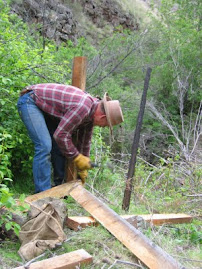
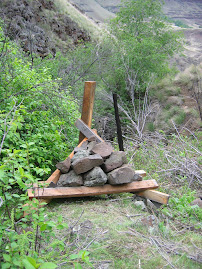
People from Wallowa County sometimes don’t realize that the rock jack is a unique fencing technique, but we’ve had many a visitor ask us what those triangular structures and piled up rocks are all along the fenceline. In most places, people just drive posts into the ground. On Wallowa County rangeland, much of the ground is rock, and there is no way you’re going to sink a post into it. There is also the issue of remoteness. Many fences can only be reached by horseback and wooden fence material packs better on a horse than metal posts do.
The art of rock jack building is passed down from one fencer to another and it starts with good material. Mike’s first job in Wallowa County was splitting 9,000 pieces of tamarack fence material for the US Forest Service. He and Jay Penniman searched out enormous dead-standing tamarack trees and felled them. They sawed the downed trees into lengths and laid into them with maul and wedge to split them into 4 ft posts and 4 ½ ft stays.
I can still remember the sweat glistening on the men’s necks and the ring of their mauls biting into the pumpkin colored wood. It fascinated me, the clean straight grain of the tamarack splitting sharply into what seemed like impossibly long lengths of material. Standing beside one of the enormous logs, I imagined the wood slabbed off into shakes, boards, timbers, shingles, everything you would need to build a hand-hewn house. What a remarkable resource.
Mike’s rock jack techniques have been honed over years of fencing. First contracts, then building and maintaining fence on the ranches we worked for, and now on our own fences at the Magpie Ranch. One year we built fence for McClarans on Pine Creek and camped out in our wall tent all summer. While I worked alongside Mike, the kids played He-Man, using the flatbed truck for a fort with the dog-catcher over the cab as their watchtower. Prairie even came up with a new armored hairstyle by working a handful of fence staples into the crown of her tightly braided hair. My job was to attach the fence stays to the newly strung wire. After a mile’s worth of days of hammering staples into twangy tamarack, I got used to waking up with swollen hands that could barely make a fist and I developed a healthy respect for fence builders.
Out on the Zumwalt, the resident elk herd migrates through our range on a daily basis and can flatten a fence without batting an eyelash. Mike is perfecting the art of keeping the fence just loose enough for the resident elk herd to pass over, and just tight enough to keep our cow herd from deciding to go visit the neighbors.
Building good rangeland fences requires skill. With steep ground, determined animals, and gravity to contend with, I know how important every angle is, the choice of each piece of material, the placement of the rocks on the deck and the height of each wire. And yes, fence building has appeared in one of my favorite poems, a love poem of course. I’ll share an excerpt here, but if you want the whole poem, you’ll have to ask me for it. And by the way, since Mike’s not entering the contest, I’m rooting for Bryan Baquet.
Excerpt from
February, Horse Creek
When you wake up
we haul two jack’s material
down slope and build fence.
I love this just as much,
mu diagonal fitting your upright,
the wire I lift and hold in place
as if all the world could be held by one wire
strung just right.
From the Magpie Ranch, home of Bunchgrass Beef
People from Wallowa County sometimes don’t realize that the rock jack is a unique fencing technique, but we’ve had many a visitor ask us what those triangular structures and piled up rocks are all along the fenceline. In most places, people just drive posts into the ground. On Wallowa County rangeland, much of the ground is rock, and there is no way you’re going to sink a post into it. There is also the issue of remoteness. Many fences can only be reached by horseback and wooden fence material packs better on a horse than metal posts do.
The art of rock jack building is passed down from one fencer to another and it starts with good material. Mike’s first job in Wallowa County was splitting 9,000 pieces of tamarack fence material for the US Forest Service. He and Jay Penniman searched out enormous dead-standing tamarack trees and felled them. They sawed the downed trees into lengths and laid into them with maul and wedge to split them into 4 ft posts and 4 ½ ft stays.
I can still remember the sweat glistening on the men’s necks and the ring of their mauls biting into the pumpkin colored wood. It fascinated me, the clean straight grain of the tamarack splitting sharply into what seemed like impossibly long lengths of material. Standing beside one of the enormous logs, I imagined the wood slabbed off into shakes, boards, timbers, shingles, everything you would need to build a hand-hewn house. What a remarkable resource.
Mike’s rock jack techniques have been honed over years of fencing. First contracts, then building and maintaining fence on the ranches we worked for, and now on our own fences at the Magpie Ranch. One year we built fence for McClarans on Pine Creek and camped out in our wall tent all summer. While I worked alongside Mike, the kids played He-Man, using the flatbed truck for a fort with the dog-catcher over the cab as their watchtower. Prairie even came up with a new armored hairstyle by working a handful of fence staples into the crown of her tightly braided hair. My job was to attach the fence stays to the newly strung wire. After a mile’s worth of days of hammering staples into twangy tamarack, I got used to waking up with swollen hands that could barely make a fist and I developed a healthy respect for fence builders.
Out on the Zumwalt, the resident elk herd migrates through our range on a daily basis and can flatten a fence without batting an eyelash. Mike is perfecting the art of keeping the fence just loose enough for the resident elk herd to pass over, and just tight enough to keep our cow herd from deciding to go visit the neighbors.
Building good rangeland fences requires skill. With steep ground, determined animals, and gravity to contend with, I know how important every angle is, the choice of each piece of material, the placement of the rocks on the deck and the height of each wire. And yes, fence building has appeared in one of my favorite poems, a love poem of course. I’ll share an excerpt here, but if you want the whole poem, you’ll have to ask me for it. And by the way, since Mike’s not entering the contest, I’m rooting for Bryan Baquet.
Excerpt from
February, Horse Creek
When you wake up
we haul two jack’s material
down slope and build fence.
I love this just as much,
mu diagonal fitting your upright,
the wire I lift and hold in place
as if all the world could be held by one wire
strung just right.
From the Magpie Ranch, home of Bunchgrass Beef
Sunday, August 9, 2009
Circling Back
Little Duke was not little. The cowboys named him that to differentiate him from his dad, Old Duke, who eventually became Duke Whitey, because of his thick white hair. Both Dukes are part of a long line of Phillips, which I think is now up to Duke the Fourth with Little Duke’s son. In my family nobody has ever made it past Junior, so this feels weighty to me.
I met Little Duke when he knocked on our door to offer Mike a job day riding. We didn’t have a phone so he had driven the eighteen miles out to our place and since Mike wasn’t there, he delivered the message to me. It was a brief conversation. I had yet to discover that it would be the beginning of years of working together and many late night campfire barbecues, with guitars, poetry and stories.
The Phillips came to the Snake River from Old Mexico. They were Texans, but grew up on a ranch south of the border. Duke and his brother Scott were our age and both spent time on the Oregon ranch between college and getting married. Their ranch included Dug Bar, Horse Creek, Camp Creek and Target Springs.
Horse Creek is now part of our winter range. The house is actually on the Imnaha River, and the range extends into a fork of Horse Creek. My first memory of Horse Creek is from a cattle drive from Dug Bar to Camp Creek. We overnighted at the Horse Creek house and our black half-wild pup escaped the truck and disappeared during a storm. The next morning after the cowboys headed out, Duke came riding back with the bedraggled pup under his arm. He had spotted him halfway up a rim downriver, said he looked just like a bear cub crawling through the rocks. That’s how one of our best dogs got the name Oso, Spanish for bear.
Phillips later hired Mike and I to build a large feedbunk on the river bar across from the house. We toiled for a couple weeks, setting the heavy railroad tie posts into the dense cobble of the river bar, sometimes unearthing enormous boulders and slabs of basalt. That feeder was stout and meant to last. In the evenings, I pulled books of poetry from Little Duke’s shelves and discovered the Chilean writer, Pablo Neruda, poems in Spanish that eventually led to our family moving to Ecuador for a year. The Phillips left the country after less than a decade (winters were too long) and settled back in the Southwest, but Mike and I still think of them. Especially last year as we labored to yank those same feedbunk posts out of the ground.
We laughed about the irony of our efforts, but under our management that patch of riverbar is one of our main restoration projects. After clearing out the feeder, burning and reseeding the bar with a rangeland drill, we are satisfied to see the new grass taking hold, the weeds becoming fewer and fewer. We admire the athletic river otters who make their way to a favorite fishing hole in late winter and we welcome the pairs of wild geese arriving to nest on the bar in spring. We think of our own migrations, one ranch to another, winter range to summer. People come and go, ranches change hands, decisions or weather take their toll for a time, or improve things. We keep circling back and when we arrive, we say, here we are again, and we look at what needs to be done.
From the Magpie Ranch, home of Bunchgrass Beef
I met Little Duke when he knocked on our door to offer Mike a job day riding. We didn’t have a phone so he had driven the eighteen miles out to our place and since Mike wasn’t there, he delivered the message to me. It was a brief conversation. I had yet to discover that it would be the beginning of years of working together and many late night campfire barbecues, with guitars, poetry and stories.
The Phillips came to the Snake River from Old Mexico. They were Texans, but grew up on a ranch south of the border. Duke and his brother Scott were our age and both spent time on the Oregon ranch between college and getting married. Their ranch included Dug Bar, Horse Creek, Camp Creek and Target Springs.
Horse Creek is now part of our winter range. The house is actually on the Imnaha River, and the range extends into a fork of Horse Creek. My first memory of Horse Creek is from a cattle drive from Dug Bar to Camp Creek. We overnighted at the Horse Creek house and our black half-wild pup escaped the truck and disappeared during a storm. The next morning after the cowboys headed out, Duke came riding back with the bedraggled pup under his arm. He had spotted him halfway up a rim downriver, said he looked just like a bear cub crawling through the rocks. That’s how one of our best dogs got the name Oso, Spanish for bear.
Phillips later hired Mike and I to build a large feedbunk on the river bar across from the house. We toiled for a couple weeks, setting the heavy railroad tie posts into the dense cobble of the river bar, sometimes unearthing enormous boulders and slabs of basalt. That feeder was stout and meant to last. In the evenings, I pulled books of poetry from Little Duke’s shelves and discovered the Chilean writer, Pablo Neruda, poems in Spanish that eventually led to our family moving to Ecuador for a year. The Phillips left the country after less than a decade (winters were too long) and settled back in the Southwest, but Mike and I still think of them. Especially last year as we labored to yank those same feedbunk posts out of the ground.
We laughed about the irony of our efforts, but under our management that patch of riverbar is one of our main restoration projects. After clearing out the feeder, burning and reseeding the bar with a rangeland drill, we are satisfied to see the new grass taking hold, the weeds becoming fewer and fewer. We admire the athletic river otters who make their way to a favorite fishing hole in late winter and we welcome the pairs of wild geese arriving to nest on the bar in spring. We think of our own migrations, one ranch to another, winter range to summer. People come and go, ranches change hands, decisions or weather take their toll for a time, or improve things. We keep circling back and when we arrive, we say, here we are again, and we look at what needs to be done.
From the Magpie Ranch, home of Bunchgrass Beef
Wednesday, July 29, 2009
Remedy
Today I was reminded of a tried and true companion that has travelled with me from the Okanogan to the Yukon to Hells Canyon and the Wallowa Valley. I’m talking about The Herb Book by John Lust. The subject of the book came up over dinner when we were discussing a malady that has afflicted me the last few weeks, the nasty rash, swelling and pain caused by exposure to Rhus radicans L, poison ivy.
Since I have been affected before, I know what poison ivy (commonly referred to in these parts as poison oak) looks like and I avoid it like the plague. But I still get it several times a year, from Mike, the dogs, tools, laundry, etc. This time I suspect I got it from the horses. When Mike and our good friend Bryan trailed the cows up Log Creek to the summer range, they said they went through a “jungle” of poison oak. I remembered not to touch the dogs, but I forgot about the horses.
The Herb Book contains a startling amount of information on useful plants. It not only includes botanical information, but also educates the reader on medicinal terminology, methods of preparation, nutritional properties, other useful properties, herbal formulas, plant lore and has several comprehensive indexes. Yellowed and worn, I grabbed the compact and dense paperback from my kitchen cupboard and showed it to my friend at the dinner table. “Wow,” she said, “I’ve never used a book enough to have it look like this.”
That’s when I realized how many times this book has helped me treat various illnesses, wounds and discomforts for myself and my family. Living in remote areas, I could often use this resource to find herbal relief in my cupboard, garden, or surrounding landscape. Just a few days ago, I used it to review the properties of my chosen remedy for poison oak and refresh my memory on preparation, dosage and application.
I have heard of many “treatments” for poison oak, everything from bleach and kerosene, to scratching-the-heck-out-of-it, to steroids and shots of whiskey. The remedy I prefer is a decoction of black walnut leaves. Luckily, Mike was heading down river so he picked some fresh leaves for me. As a plant person recently reminded me, the treatment for offensive plants is generally another plant that grows in the same region.
In this case, I used two remedies.
Black Walnut Poison Oak Remedy
Simmer a couple cups of whole fresh leaves in about a quart of water for 5 - 10 minutes. (Dry leaves can be substituted for fresh, simmer 10 minutes.) Let cool. Pour leaves and decoction into a glass jar and store in the fridge. If you are not going to use it up in a week or so, strain and discard the leaves before storing the liquid. Soak a small cloth in the liquid and apply it to the affected area for several minutes, three or four times a day. It helps relieve itching and dry out the rash.
The Other “Remedy”
I hiked from Buckhorn Springs out the end of the ridge above Tulley Creek. A storm was gathering, with fretful winds, dull yellow underbellies of thunderheads, and dark curtains of rain trailing south. When I reached a rock knob at the end of the ridge, I looked down to the Tulley Creek bench below, and the spot where our first home in Wallowa County still squats beside the creek in a ribbon of birch, alder, and willow.
I sat down to contemplate the vast expanse before me and suddenly the world was becalmed. Not a breath of wind, not a bird singing, not even a fly buzzing. It was utterly still. The kind of quiet you can feel on your skin.
Now that kind of remedy works for most anything.
Since I have been affected before, I know what poison ivy (commonly referred to in these parts as poison oak) looks like and I avoid it like the plague. But I still get it several times a year, from Mike, the dogs, tools, laundry, etc. This time I suspect I got it from the horses. When Mike and our good friend Bryan trailed the cows up Log Creek to the summer range, they said they went through a “jungle” of poison oak. I remembered not to touch the dogs, but I forgot about the horses.
The Herb Book contains a startling amount of information on useful plants. It not only includes botanical information, but also educates the reader on medicinal terminology, methods of preparation, nutritional properties, other useful properties, herbal formulas, plant lore and has several comprehensive indexes. Yellowed and worn, I grabbed the compact and dense paperback from my kitchen cupboard and showed it to my friend at the dinner table. “Wow,” she said, “I’ve never used a book enough to have it look like this.”
That’s when I realized how many times this book has helped me treat various illnesses, wounds and discomforts for myself and my family. Living in remote areas, I could often use this resource to find herbal relief in my cupboard, garden, or surrounding landscape. Just a few days ago, I used it to review the properties of my chosen remedy for poison oak and refresh my memory on preparation, dosage and application.
I have heard of many “treatments” for poison oak, everything from bleach and kerosene, to scratching-the-heck-out-of-it, to steroids and shots of whiskey. The remedy I prefer is a decoction of black walnut leaves. Luckily, Mike was heading down river so he picked some fresh leaves for me. As a plant person recently reminded me, the treatment for offensive plants is generally another plant that grows in the same region.
In this case, I used two remedies.
Black Walnut Poison Oak Remedy
Simmer a couple cups of whole fresh leaves in about a quart of water for 5 - 10 minutes. (Dry leaves can be substituted for fresh, simmer 10 minutes.) Let cool. Pour leaves and decoction into a glass jar and store in the fridge. If you are not going to use it up in a week or so, strain and discard the leaves before storing the liquid. Soak a small cloth in the liquid and apply it to the affected area for several minutes, three or four times a day. It helps relieve itching and dry out the rash.
The Other “Remedy”
I hiked from Buckhorn Springs out the end of the ridge above Tulley Creek. A storm was gathering, with fretful winds, dull yellow underbellies of thunderheads, and dark curtains of rain trailing south. When I reached a rock knob at the end of the ridge, I looked down to the Tulley Creek bench below, and the spot where our first home in Wallowa County still squats beside the creek in a ribbon of birch, alder, and willow.
I sat down to contemplate the vast expanse before me and suddenly the world was becalmed. Not a breath of wind, not a bird singing, not even a fly buzzing. It was utterly still. The kind of quiet you can feel on your skin.
Now that kind of remedy works for most anything.
Saturday, July 25, 2009
Prairie Terroir
Luckily there was a breeze on the Zumwalt today. It’s hot. It’s July. Out in the open, where the sun is baking the range, there’s the pungent smell of tarweed and yarrow. I like that smell.
This morning Mike dropped me off at the pond and I hiked the upper fence, checking for holes where the elk wander through on their daily travels. I climbed above the head of Alder Creek and crossed a swath of biscuit-scab terrain, the interesting mounds of vegetated soil with rocky bare channels between. Nobody knows for sure what resulted in this unique rangeland feature, some say glaciers, others geologic floods, and once I even heard a theory about giant prehistoric gophers!
In spite of the dryness, there were still wildflowers: pink buckwheat, lilac erigeron, magenta dianthus, purple-blue penstomon. I followed the fence off the top down into a stand of Ponderosa Pine, thankful for the shade. In the dappled shadows, the grass was green and lush, with birds flitting and calling among the trees and shrubs. I swear I could smell the huckleberries ripening, even though I couldn’t find any.
Every time I look up into a big old Ponderosa Pine, I think of cougars. I think of how a cougar can jump almost twenty feet straight up, easy as pie. I look at those massive tree limbs arching out from the trunk and I think to myself, “If I were a cougar I’d hop up there, drape myself along that branch and take a nap.”
No cougars today, but lots of birds and butterflies and our cow herd happily wandering the range, enjoying the breeze just like me. Out in the open, I was reminded how beastly hot it gets on the Zumwalt, how when we lived at the Steen Place the kids would try and swim in Chesnimnus Creek even though it hardly had any water in it. They wandered along the creek bed looking for holes deep enough to wallow in and came back to the house covered in mud. I had to pump a couple buckets from the well and douse them off before I could let them in.
The Steen Place is a big two story hundred year old log house at the edge of the prairie. We summered there off and on over the years, and we have many memories of good times and hard work with the folks who cowboyed together there. It seemed we always had some project going to try to fix up the house. One spring the pack rats packed 50 pounds of dog food, one piece at a time, from the front porch up into the attic where it collapsed the ceiling and fell through into the bedroom below. We got new sheetrock on the ceiling that summer. When the ranch sold recently, people stopped living there. I wonder if it will ever be cared for as anyone’s home again.
The Steen Place is just one more reason why I love this country. The open rolling grassland, the mosaic of timber, the deep red canyons, the wide benchlands, the lush dynamic river bottoms. Like the grass and the cattle, we have become the product of its soil, climate and culture. This is our terroir.
This morning Mike dropped me off at the pond and I hiked the upper fence, checking for holes where the elk wander through on their daily travels. I climbed above the head of Alder Creek and crossed a swath of biscuit-scab terrain, the interesting mounds of vegetated soil with rocky bare channels between. Nobody knows for sure what resulted in this unique rangeland feature, some say glaciers, others geologic floods, and once I even heard a theory about giant prehistoric gophers!
In spite of the dryness, there were still wildflowers: pink buckwheat, lilac erigeron, magenta dianthus, purple-blue penstomon. I followed the fence off the top down into a stand of Ponderosa Pine, thankful for the shade. In the dappled shadows, the grass was green and lush, with birds flitting and calling among the trees and shrubs. I swear I could smell the huckleberries ripening, even though I couldn’t find any.
Every time I look up into a big old Ponderosa Pine, I think of cougars. I think of how a cougar can jump almost twenty feet straight up, easy as pie. I look at those massive tree limbs arching out from the trunk and I think to myself, “If I were a cougar I’d hop up there, drape myself along that branch and take a nap.”
No cougars today, but lots of birds and butterflies and our cow herd happily wandering the range, enjoying the breeze just like me. Out in the open, I was reminded how beastly hot it gets on the Zumwalt, how when we lived at the Steen Place the kids would try and swim in Chesnimnus Creek even though it hardly had any water in it. They wandered along the creek bed looking for holes deep enough to wallow in and came back to the house covered in mud. I had to pump a couple buckets from the well and douse them off before I could let them in.
The Steen Place is a big two story hundred year old log house at the edge of the prairie. We summered there off and on over the years, and we have many memories of good times and hard work with the folks who cowboyed together there. It seemed we always had some project going to try to fix up the house. One spring the pack rats packed 50 pounds of dog food, one piece at a time, from the front porch up into the attic where it collapsed the ceiling and fell through into the bedroom below. We got new sheetrock on the ceiling that summer. When the ranch sold recently, people stopped living there. I wonder if it will ever be cared for as anyone’s home again.
The Steen Place is just one more reason why I love this country. The open rolling grassland, the mosaic of timber, the deep red canyons, the wide benchlands, the lush dynamic river bottoms. Like the grass and the cattle, we have become the product of its soil, climate and culture. This is our terroir.
Saturday, July 18, 2009
Velvet and Luminous
In his collection Elemental Odes, Chilean poet Pablo Neruda has written some of the most sensuous love poems in history. Consider this excerpt from Ode to the Onion:
In the garden, the earth heaped up her power showing your naked transparency and as the remote sea in lifting the breasts of Aprhodite duplicated the magnolia, so did the earth make you.
Yes, one can write a love poem about a vegetable or a fruit.
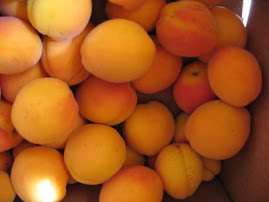
Like the intoxicating and voluptuous apricot. Three pickings already this week and now they are dozing in boxes in the basement, ripening, ripening.
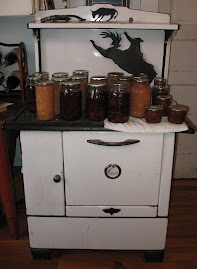
Evenings I break a sweat carving their little orbs into the makings of luminescent preserves, racks loaded for the fruit dryer and quarts of perfect halves floating in their exquisite nectar.
Poet and professor David Wagoner talks about feeling like he was using the same words over and over in his poems. When he examined his work, he found the six words that his poetry lived on: wind, bird, tree, water, grass, and light.
Apricot is one of my words.
I feel a sense of embarrassment every time the apricot appears in another of my poems, but I can’t help it. Sometimes they just sneak in there. And this is definately one of those moments. They are such a gift.
Canyon Apricots
And come the long baked days of summer
I return for the harvest glowing
among the fluttering leaves. Velvet
shoulders gently plucked from stems,
and lolling in my palm, the succulence
of blushing cheek and silken cleft.
Again my lips reach for tender skin
the burst of flesh, sweet quenching
I can not swallow enough of.
And all this for simply needing and finding
what was left by those before us
hidden here among the rims and benches.
In the garden, the earth heaped up her power showing your naked transparency and as the remote sea in lifting the breasts of Aprhodite duplicated the magnolia, so did the earth make you.
Yes, one can write a love poem about a vegetable or a fruit.
Like the intoxicating and voluptuous apricot. Three pickings already this week and now they are dozing in boxes in the basement, ripening, ripening.
Evenings I break a sweat carving their little orbs into the makings of luminescent preserves, racks loaded for the fruit dryer and quarts of perfect halves floating in their exquisite nectar.
Poet and professor David Wagoner talks about feeling like he was using the same words over and over in his poems. When he examined his work, he found the six words that his poetry lived on: wind, bird, tree, water, grass, and light.
Apricot is one of my words.
I feel a sense of embarrassment every time the apricot appears in another of my poems, but I can’t help it. Sometimes they just sneak in there. And this is definately one of those moments. They are such a gift.
Canyon Apricots
And come the long baked days of summer
I return for the harvest glowing
among the fluttering leaves. Velvet
shoulders gently plucked from stems,
and lolling in my palm, the succulence
of blushing cheek and silken cleft.
Again my lips reach for tender skin
the burst of flesh, sweet quenching
I can not swallow enough of.
And all this for simply needing and finding
what was left by those before us
hidden here among the rims and benches.
Subscribe to:
Posts (Atom)